


MARKET SIGNAL | Image: Industry Minister Kim Jung-kwan and US Commerce Secretary Howard Lutnick. Washington D.C., May 8, 2026. (Source: Ministry of Trade, Industry and Resources)
Korea’s 1st strategic investment project under the $350 billion (KRW 507.5 trillion; all USD conversions at approximately KRW 1,450/USD) November 2025 MOU is scheduled for announcement after the US Strategic Investment Act (대미투자특별법) takes effect on June 18, 2026. The Korea–US Strategic Investment Corporation stands up immediately after.
The MOU’s public framing is mutual benefit. Korea secured US auto tariff reduction from 25% to 15% and lower semiconductor tariffs in exchange for $200 billion in cash investment and $150 billion in shipbuilding cooperation over ten years, capped at $20 billion per year (Reuters, November 14, 2025; Korea Herald, November 26, 2025). These structural figures rest on reporting; the MOU text itself is not public.
Industry Minister Kim Jung-kwan has publicly described the guiding principle for selecting the 1st project as “commercial rationality” (산업통상부 보도자료, May 10, 2026). The 1st-project pick is the first public test of whether that principle constrains the selection. Public tension has narrowed to two energy options — participation in a Louisiana LNG export terminal and a US-sited nuclear build. The two sides want opposite things: Korea wants the nuclear track to compound new credentials, the US wants the LNG track to solve a bankability problem. The asymmetry between them, measured by what Korean industry actually compounds and what Korean LNG buyers can responsibly commit to, is sharper than the headline.
Louisiana LNG repeats a pattern Korea has already built
Korean buyers already hold a substantial book of US Gulf Coast long-term offtake. KOGAS imports 3.5 MTPA from Cheniere’s Sabine Pass terminal (Louisiana) under a 20-year contract, with commercial deliveries from June 2017 (Cheniere press release, 2012). Another KOGAS contract with BP delivers 1.58 MTPA from Freeport TX or Calcasieu Pass LA over 15 years from 2025, with a 3-year extension option and maximum 18-year value of approximately $9.61 billion (S&P Global Platts, September 2019).
In 2025 KOGAS added two more long-term contracts sourced from US LNG portfolios. The Trafigura agreement (August 2025) is Henry Hub-indexed with volumes undisclosed (Trafigura press release, August 2025). The TotalEnergies agreement (September 2025) runs ten years, delivering 1 MTPA from late 2027 and expanding to 3 MTPA from 2028 (TotalEnergies press release, September 9, 2025). SK Innovation E&S (former SK E&S, renamed after the November 2024 SK Innovation merger) holds 2.2 MTPA from Freeport LNG Train 3 under a 20-year LTA. US shale gas deliveries to Korea began in 2020 (Freeport LNG / SK Innovation E&S disclosures).
A Korean equity position in another Louisiana terminal would not add a structurally new commercial relationship. It would deepen exposure to a routing problem Korean buyers already know.
That routing problem is the Panama Canal. According to SynMax shipping intelligence, 94% of US LNG cargoes bound for Asia took the Cape of Good Hope route in 2024, adding roughly 20 days versus a Panama transit (SynMax, “2024 Sea Change in LNG Routes”). The Panama Canal Authority declared “full water capacity” restoration in July 2025 (Lloyd’s List, July 10, 2025). Actual LNG carrier transit patterns, however, have remained volatile through 2026, shaped by demand, route economics, and event risk.
The Rio Indio reservoir project would expand canal water supply to support more transits. Construction is scheduled to begin in 2027, with completion around 2032 and total cost near $1.6 billion (CNBC, September 13, 2025). Korean buyers loading at Louisiana face the same physics they face at Freeport. Adding an equity stake does not change the route.
EPC credential is a separate question. It cuts differently than offtake. Korean E&C firms have led multi-stage EPC packages across KOGAS’s domestic LNG receiving terminal network at Pyeongtaek, Incheon, Tongyeong, and Samcheok. Korean private LNG receiving infrastructure also runs on Korean E&C. POSCO International operates the Gwangyang LNG terminal, Korea’s first private LNG import terminal. SK Innovation E&S participates in the Boryeong LNG terminal through a 50:50 joint venture with GS Energy.
On global LNG projects, Samsung Heavy Industries built the Coral South FLNG hull for Mozambique, and DSME built the 15-vessel Arc7 ice-class LNG carrier fleet for Yamal LNG. Korea does not lack LNG terminal experience.
So the relevant test for Louisiana is what it adds on top. US Gulf liquefaction EPC has been led by Bechtel (Sabine Pass, Woodside Louisiana), Worley (CP2), Kiewit (Calcasieu Pass), KBR (Plaquemines Phase 1), and Technip Energies (Commonwealth LNG) across major projects. Korean firms have not yet emerged as lead EPC contractors at US Gulf onshore liquefaction projects that have reached FID. Even if a Korean E&C firm secured lead EPC at a Louisiana terminal, the credential would stack onto an asset base Korean industry already holds. A US-sited nuclear EPC scope, by contrast, would build a credential Korean industry has not yet formed on US soil. Korean equity in a Louisiana terminal would add to an LNG asset base Korea already has, on a route that remains constrained.
The bankability problem routes back to Korean buyers
The 1st-project framing as an equity investment hides what actually makes a Louisiana LNG terminal fundable. Standard LNG export project finance closes on contracted long-term SPAs, with industry practice typically requiring two-thirds or more of project output pre-contracted before FID. Strong-sponsor and equity-backed exceptions exist but remain exceptions.
Venture Global’s CP2 Phase 1 (14.4 MTPA nameplate) reached FID on July 28, 2025 with $15.1 billion in project financing and over $34 billion in bank commitments (Venture Global 8-K, July 2025). Behind that close sat approximately 43.5 MTPA of long-term offtake across CP2 and its sister terminals at Calcasieu Pass and Plaquemines, anchored at the CP2 terminal by SPAs with Eni, Petronas, and SEFE (Venture Global press releases, 2024-2025).
Commonwealth LNG (9.5 MTPA) reached FID in May 2026 with $9.75 billion in project financing on long-term contracts with EQT, Glencore, Mercuria, Petronas, and Aramco Trading (Caturus / gCaptain, May 2026). Both pre-sold the bulk of capacity before FID. Woodside did not.
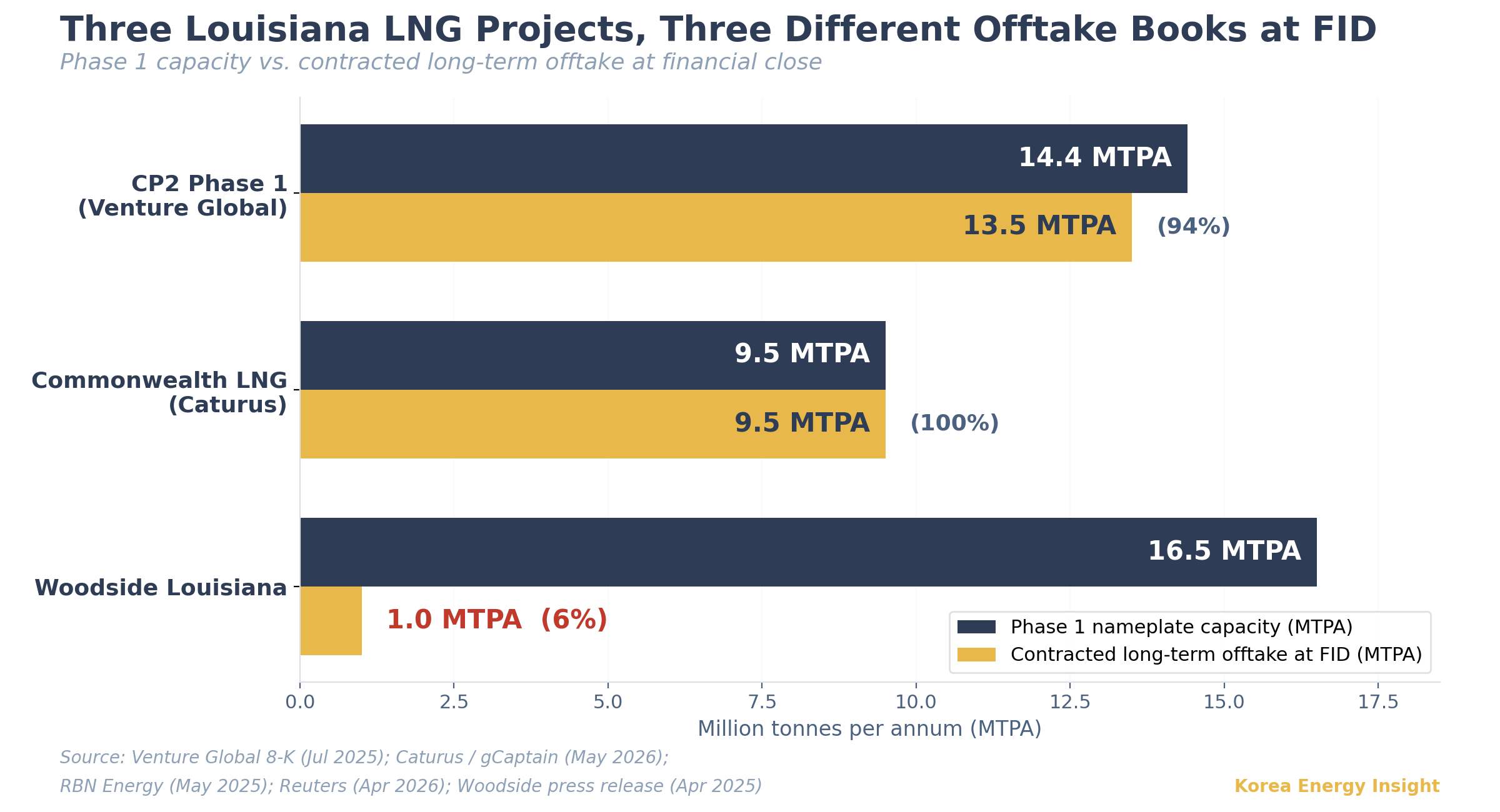
Woodside Louisiana LNG is the outlier. The project reached FID on April 29, 2025 for the 16.5 MTPA Phase 1 at $17.5 billion (KRW 25.4 trillion), the largest foreign direct investment in Louisiana state history (Woodside press release, April 29, 2025). RBN Energy reported at FID that Woodside had only 1 MTPA of the 16.5 MTPA Phase 1 under third-party long-term contract (RBN Energy, May 2025). A year later, Reuters reported in April 2026 that Woodside was still struggling to sell Louisiana LNG volumes, with Uniper essentially the lone confirmed long-term buyer. Williams agreed to 1.6 MTPA in October 2025. Stonepeak took 40% of the holding company InfraCo at FID, and Aramco signed a non-binding HOA in May 2025.
On the public financing evidence, the contracted offtake gap is the most plausible reason Louisiana LNG appears in the Korea strategic investment package while CP2 and Commonwealth do not. The real test for Korea is not equity participation. It is whether Korean buyers are asked to sign new 15- to 20-year SPAs. This is a Korean-side reading of the financing math. US negotiators and Woodside have not publicly confirmed it. The math itself is on the public record.
Korea’s incremental LNG demand cannot responsibly support that commitment. The 11th Basic Plan for Electricity Supply and Demand, finalized in February 2025, sets LNG’s share of generation (not installed capacity) at 25.1% in 2030 declining to 10.6% by 2038 (산업통상부, 제11차 전력수급기본계획). Installed LNG capacity moves the other way, rising from 43.2 GW (2023) to 58.8 GW (2030) to 69.2 GW (2038). The split is deliberate. Gas plants serve as balancing and peaking capacity rather than baseload generation.
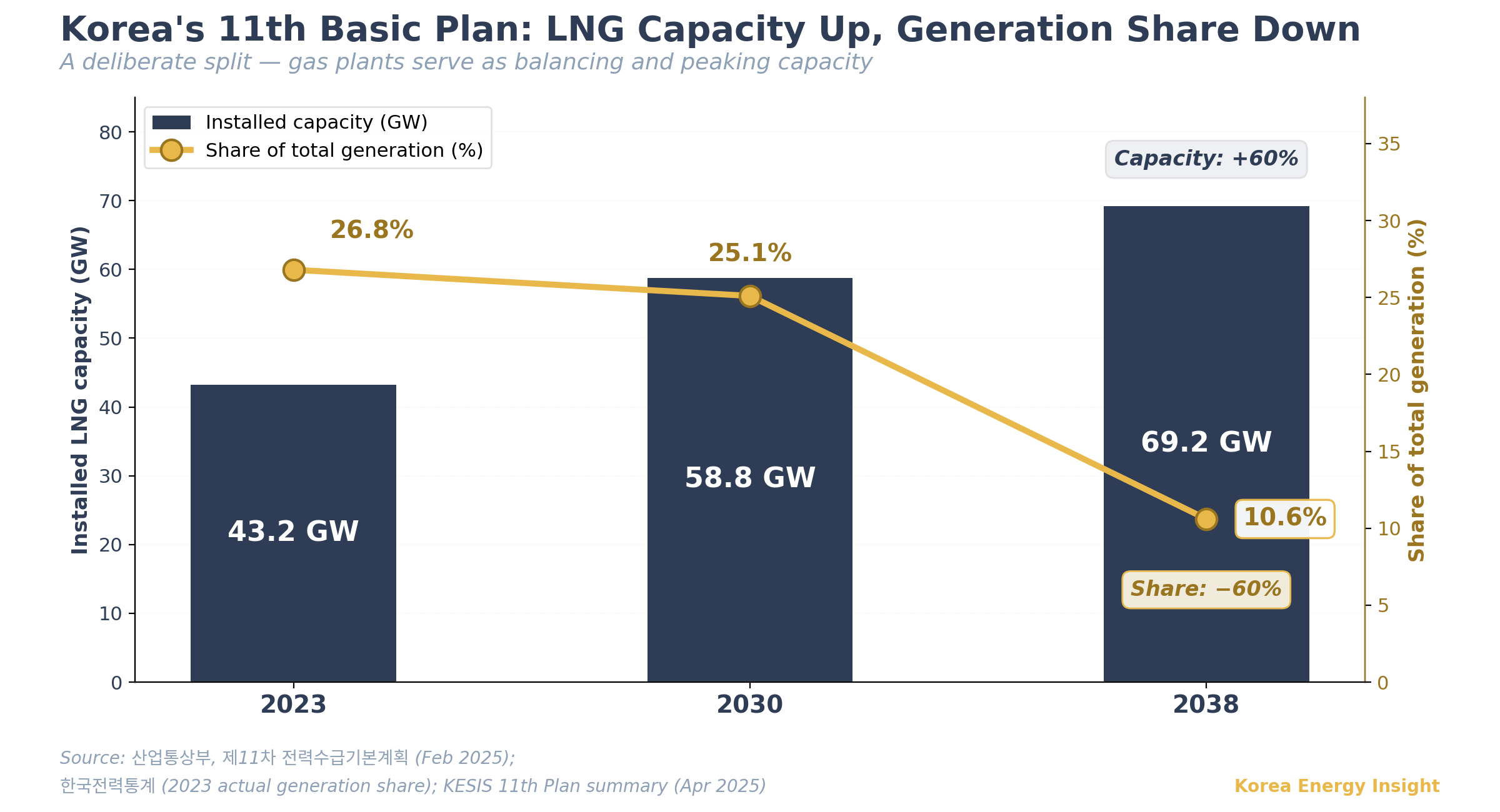
Korea’s 2040 coal phaseout pledge under the Powering Past Coal Alliance (joined at COP30, November 2025, covering 40 coal-fired units) creates a near-term coal-to-gas balloon (PPCA / 환경부, November 17, 2025). The 11th Plan absorbs that pressure through hydrogen and ammonia co-firing targets, not new long-term LNG SPAs. Co-firing reaches 2.4% of generation in 2030 and 6.2% by 2038. The October 2025 cancellation of the Clean Hydrogen Power Generation Bidding (CHPS) disrupted implementation but did not formally repeal the trajectory (KPX Notice 2025-02, October 17, 2025).
A 20-year US LNG SPA signed in 2026 runs to 2046, past the policy horizon Korea has publicly committed to. Korean buyers would absorb the bankability risk for a terminal whose output Korea no longer plans to consume at baseload scale.
New Korean LNG buyers entering the import market do not change the math. That group includes POSCO International at Gwangyang, the GS Energy–SK Innovation E&S Boryeong joint venture, Hanwha-affiliated entities, and others. They redistribute a fixed and declining domestic demand pool rather than expanding it. Their incremental contracting capacity is bounded by the same demand curve every Korean importer faces.
That said, if the 1st project is politically confirmed with a Korean LNG component, KOGAS and Korean private importers are likely to enter as SPA signatories regardless of the commercial calculus. Korea has done this before. KOGAS signed the Sabine Pass contract in 2012 and SK E&S signed the Freeport contract in 2013. Both pre-dated the Trump-1 administration. They closed during the US LNG export opening, when Korean trade and energy diversification logic aligned with US Gulf liquefaction’s need for anchor Asian buyers. In that pattern, bankability risk gets distributed across the Korean importer base under policy direction, then carried on Korean balance sheets through a declining domestic offtake curve.
Nuclear is structurally different
A US-sited APR1400 build is the best case. The design has held NRC certification since 2019 (World Nuclear News, May 2019). The NRC’s August 2025 rule extending all certified design lifetimes from 15 to 40 years means the APR1400 certification now runs to approximately 2059 (World Nuclear News, August 2025). The January 2025 KHNP–Westinghouse global settlement, with terms undisclosed, resolved the IP dispute that had threatened APR1400 third-country deployment under Westinghouse’s prior challenge (KHNP / Westinghouse joint statement, January 16, 2025). Public sources do not confirm that the settlement alone resolves all US export-control or Part 810 review requirements, but the IP overhang is removed. A US-sited APR1400 would stack Korean design, Korean supply chain, and Korean EPC as one credential package. Nothing else in the candidate set does that.
AP1000 deployment would be second-best but still substantive. The Trump administration has targeted ten new large US reactors by 2030 (Pennsylvania Energy Summit, July 15, 2025). Westinghouse is positioning the AP1000 for fleet deployment, filing Revision 20 to the design certification with the NRC in April 2026 to establish Vogtle-4 as the US reference plant (ANS Nuclear Newswire, April 2026). Project-level commitments remain at varying stages. The most advanced candidate site is V.C. Summer in South Carolina, where Brookfield Asset Management and The Nuclear Company announced a joint venture in May 2026 to complete the abandoned reactors (Canary Media, May 2026). Other potential sites include Bellefonte in Alabama, William States Lee III in South Carolina, and Turkey Point Units 6 and 7 in Florida. They hold valid licensing or planning status, but development momentum varies.
Korean EPC building a US-sited AP1000, and Korean equipment vendors entering the supply chain, would create genuine US nuclear construction credentials Korean firms can leverage on follow-on US and third-country deployments. Either nuclear path returns to Korea as industrial capacity that did not exist before. The Louisiana terminal does not.
The politicization layer
The 1st-project announcement will likely arrive as a multi-project package rather than a clean single pick. President Lee reportedly proposed a Korea–US currency swap to Treasury Secretary Bessent around May 14, 2026 (Seoul Economic Daily, May 14, 2026). Public reporting framed the proposal as a dollar-liquidity and FX-stability instrument alongside the $350 billion investment commitment. The interpretation that the swap is offered as compensation for accepting commercially weaker investment projects is a Korean-side analytical reading. It is not directly confirmed in primary reporting.
The key distinction is not whether Louisiana LNG appears in the package. It is whether Korean participation stops at equity and EPC sub-supplier level, within Korea’s $200 billion cash envelope. Or whether it escalates into KOGAS, SK Innovation E&S, or the broader Korean importer base being asked to commit to a new long-term SPA. Korea’s “commercial rationality” principle will be tested most clearly by what does not appear in the package: a new 15- to 20-year Korean buyer SPA signed against a declining domestic demand curve.
Base case
A multi-project announcement in late June or July 2026. Louisiana LNG participation framed as Korean equity, EPC sub-supplier scope, and Korean LNG carrier orders for Hanwha Ocean and Samsung Heavy Industries. No new long-term SPAs from KOGAS, SK Innovation E&S, or new private importers. A nuclear track included at MOU or framework level. APR1400 site selection unlikely in the first announcement. AP1000 with Korean EPC scope at V.C. Summer, the most advanced candidate site, is the most realistic near-term path.
What I’m watching
(1) Whether the announcement names a specific reactor design and site, or stays at framework level. (2) Korean E&C firms’ role in any LNG terminal selection: lead EPC, BOP scope, or sub-supplier only. (3) Whether any Korean LNG importer signs a new long-term US LNG SPA tied to the 1st project: KOGAS, SK Innovation E&S, POSCO International, GS Energy, or others. This would be the clearest sign that “commercial rationality” was no longer the binding constraint. (4) Westinghouse’s public posture toward Korean EPC participation in US-sited AP1000 builds, given that the January 2025 settlement resolved the IP dispute but not necessarily all third-country deployment terms. (5) Whether the Korea–US Strategic Investment Corporation funds Korean industrial participation or accepts financial structures in which Korean industrial participation remains limited.
What would change my mind
Three scenarios would change my mind. Louisiana LNG announced as the sole 1st project without a parallel nuclear track on a specified timeline. KEPCO and KHNP balance-sheet constraints forcing Korea to accept passive equity rather than EPC and supply-chain scope. Or Westinghouse publicly conditioning AP1000 cooperation in ways that exclude Korean EPC at the lead level. Any of these would point to a more transactional package that adds little to Korea’s US industrial credential base.
If this helps frame the June announcement, please share it with colleagues tracking Korea–US energy infrastructure exposure.