


DEEP DIVE
In December 2023, Korea’s 6th Hydrogen Economy Committee finalized the country’s clean hydrogen certification threshold at 4 kgCO₂eq per kg H₂ on a Well-to-Gate boundary, with a four-tier grading system underneath: Tier 1 at 0.1 kg or below, Tier 2 from 0.1 to 1 kg, Tier 3 from 1 to 2 kg, and Tier 4 from 2 to 4 kg (Ministry of Trade, Industry and Energy, Dec 2023). Tier 1, the lowest-emission bracket, receives the highest grading score in the CHPS auction, with lower tiers scoring progressively less. A higher score improves the chance of clearing the fixed 15-year contract volume. The headline number matches the US Department of Energy’s initial Clean Hydrogen Production Standard. The path Korea took to that number, and what has happened since, is the part foreign investors should care about.
The blue hydrogen coalition wanted 5 kg, with shipping and imported-LNG upstream emissions excluded from the boundary altogether. The argument was Korea-specific: at a November 2022 National Assembly forum, Dan Hee-soo, then with SK E&S (now SK Innovation E&S after the November 2024 merger), noted that Europe could afford a 3.4 kg threshold because its producers sit on a continental gas pipeline network, while Korean producers cannot control LNG upstream emissions that sit with foreign exporters (Electimes, Nov 2022). The government conceded the shipping carve-out as a temporary measure but held the line on the threshold itself. By March 2024, when the Korea Energy Economics Institute published the operating rules, industry observers were noting that the final standard would make domestic blue hydrogen production commercially difficult under it (KEEI, Mar 2024). That is where the certification standard stopped being the binding constraint and the auction design took over.
The Auction Already Told the Market
The threshold set the eligibility gate. What decided whether any eligible bid could actually clear the market was the auction’s price ceiling, contract length, and grading weights.
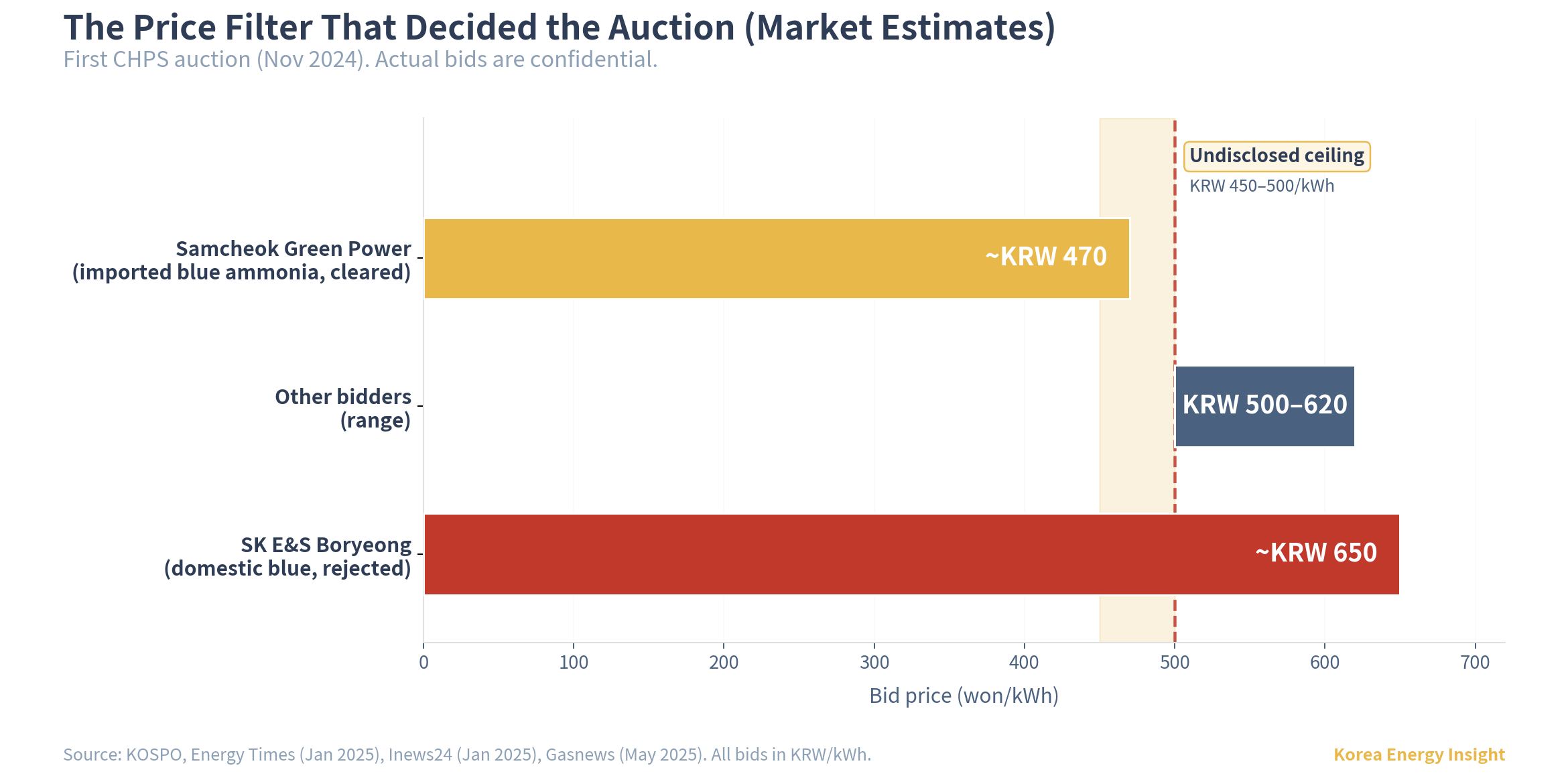
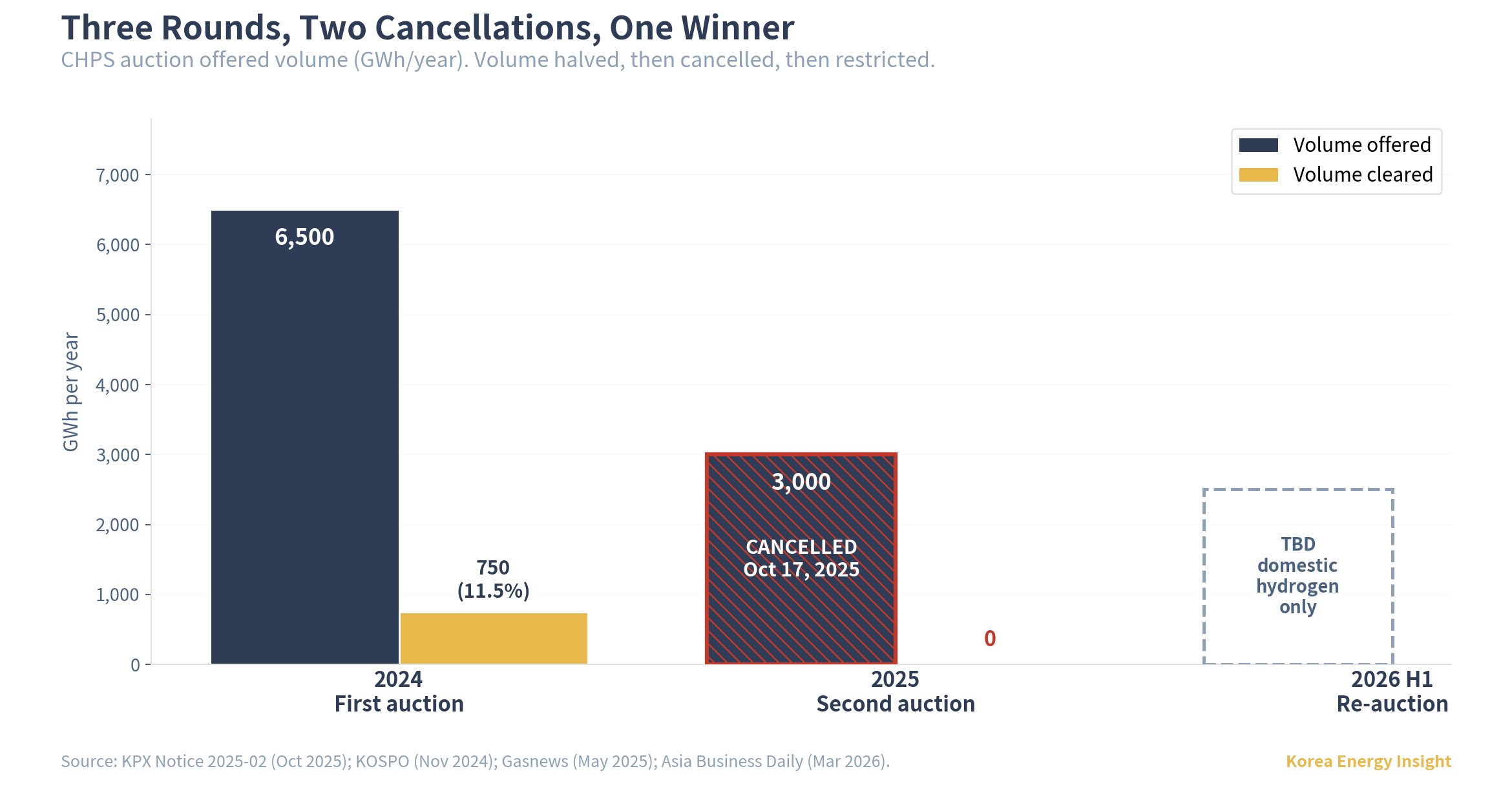
Korea launched the world’s first clean hydrogen power auction in May 2024 — 6,500 GWh of annual generation volume on offer, 15-year long-term contracts with auction-set settlement terms, and grading scores set to favor Tier 1. By November, only one winner had cleared: Korea Southern Power’s Samcheok Green Power Unit 1, contracted for 750 GWh of 20% ammonia co-firing using imported blue ammonia supplied by Samsung C&T (KOSPO, Nov 2024). That covered roughly 11.5% of the volume offered. The undisclosed ceiling was reportedly around KRW 450–500/kWh (Energy Times, Jan 2025); most bidders other than Samcheok submitted in the KRW 500s to low KRW 600s and were rejected. The result mapped the March 2024 KEEI warning directly. The only winning volume was imported blue ammonia, while domestic blue hydrogen did not clear. SK Innovation E&S’s Boryeong project, reportedly the only non-KEPCO private bidder, was rejected at the price filter.
The 2025 round was scaled down to 3,000 GWh, reopened in May 2025 with new currency-linked settlement and volume-borrowing provisions designed to attract bidders. On October 17, 2025 — the day bids were due — the Korea Power Exchange cancelled the entire auction by subsequent notice (the auction had been opened under KPX Notice 2025-02). The Ministry of Climate, Energy and Environment (기후에너지환경부, MCEE), which had taken over hydrogen policy from MOTIE under the new administration, flagged an inconsistency between the 15-year CHPS contract structure and the Lee Jae-myung government’s stated goal of phasing out coal power by 2040 (Newstapa, Oct 2025). A winning coal-ammonia co-firing bid locked in at 2025 would have kept coal units running until 2043 or 2044. Bids that companies had spent a year preparing were returned on the morning of the deadline.
The official one-sentence rationale does not explain why LNG-hydrogen co-firing bids were pulled at the same time. That gap is the part to watch.
In March 2026, press reports indicated that the first-half 2026 re-auction would restrict eligible fuel to domestically produced hydrogen only, with lead times extended up to six years, and a government source framing the direction as “building up the domestic green hydrogen ecosystem rather than expanding volume” (Asia Business Daily, Mar 2026). Even the Samcheok contract, already locked in, is now working against the tide — Samsung C&T is reportedly shifting the fuel supply source from Saudi Aramco to India (Asia Business Daily, Mar 2026). The single winner of the first auction is increasingly likely to be the last bid of its kind.
Blue Hydrogen Was Supposed to Be the Bridge
Korea’s structural problem with clean hydrogen is not ideological. It is geographic and economic. Domestic green hydrogen is priced out by the country’s land costs and renewable LCOE — Korea sits among the highest LCOH markets globally, with domestic green hydrogen running materially higher than domestic blue by KEEI estimates (KEEI, 2024). Grey hydrogen is technically available as a byproduct of refining operations, but it is consumed back within the refining process itself and is not a tradable supply source for the power sector. That leaves blue hydrogen — LNG reforming plus carbon capture — as the only pathway that can produce meaningful volumes inside Korea in the near term. Blue hydrogen was the bridge, and it still is in concept. The problem is that the bridge does not have foundations on the Korean side.
The 11th Basic Plan for Electricity Supply and Demand sets a 2030 hydrogen power generation target of about 15.5 TWh. No combination of Korea’s currently operating green and pink hydrogen pilots comes close to fueling that volume — the gap is on the order of two to three orders of magnitude — and the supply pathways that could fill it are the ones the current auction structure does not let clear. The 2030 target is also tied to Korea’s NDC commitment, which makes lowering it a non-starter. The question is not whether the 15.5 TWh target is met. It is which pathway absorbs the gap when the deadline arrives.
As of early 2026, Korea has no commercial-scale CO₂ storage. The domestic capture rate remains low, and major scaling scenarios contemplate shipping captured CO₂ to depleted overseas gas fields — a logistics cost that is added to an already-expensive molecule, and a step that raises Well-to-Gate emissions even before the certification tier is calculated.
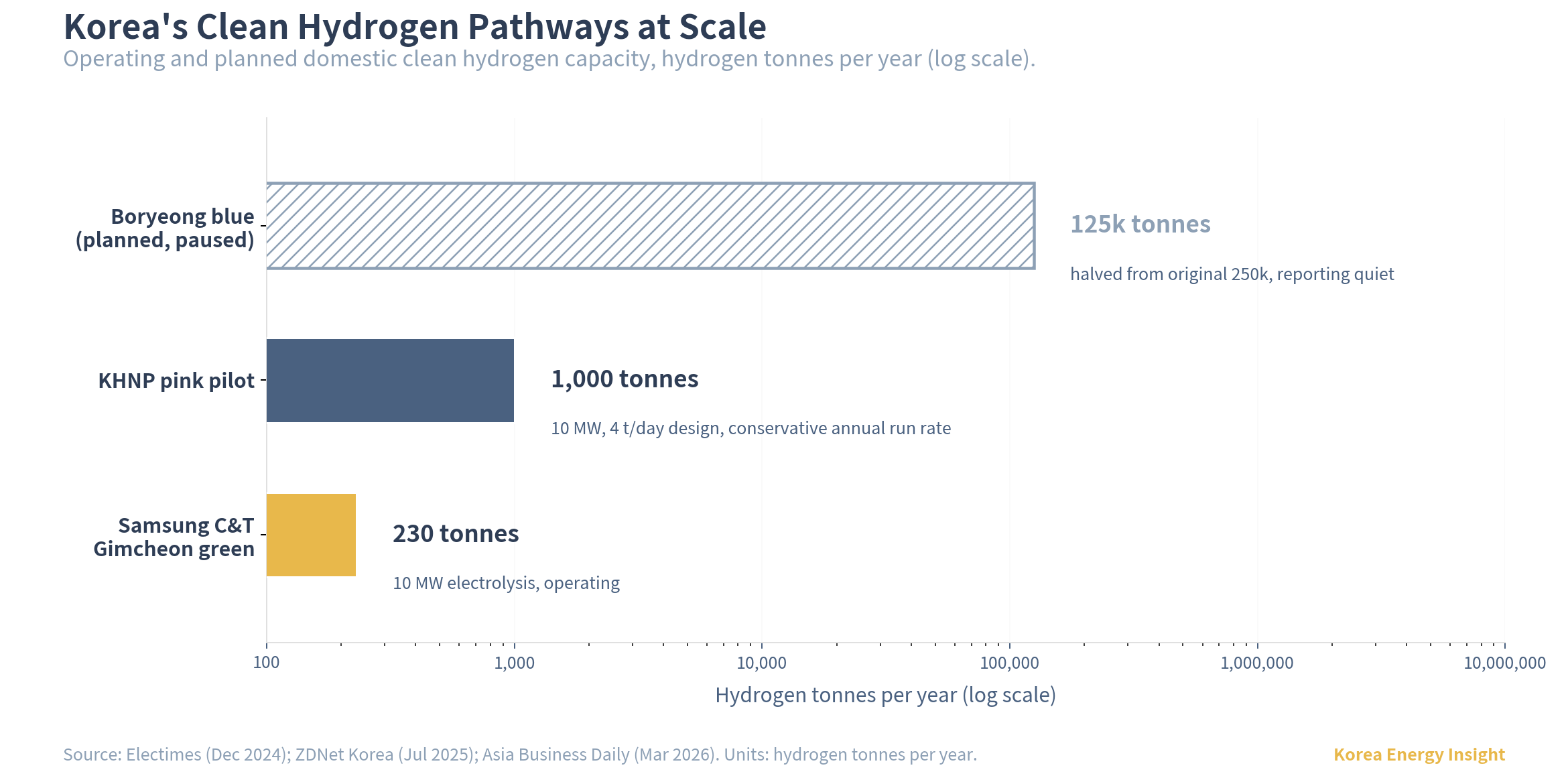
SK Innovation E&S’s Boryeong blue hydrogen project illustrates the problem directly. The project was originally announced as a 250,000 tonne-per-year facility in partnership with Korea Midland Power, with operations planned for 2025. In early 2024 the planned capacity was halved to 125,000 tonnes per year and the commissioning date pushed to 2027 as of late-2024 reporting (Electimes, Dec 2024). Public reporting on the construction schedule has gone quiet since, and no termination or withdrawal has been announced. Boryeong was the offtake host behind the company’s CHPS bid, reported by industry coverage at around KRW 650/kWh — roughly 30 to 40 percent above the reported ceiling. Industry coverage characterized this as a deliberate choice: the company declined to submit at a price it could not defend commercially (Inews24, Jan 2025). Near-term, the company’s hydrogen focus has shifted to its Incheon liquefied hydrogen plant, producing about 30,000 tonnes per year from by-product sources since 2024 (SK Innovation E&S, 2024). The Boryeong project itself remains on the books as a joint program with Korea Midland Power, but the commercial case for domestic blue hydrogen inside the CHPS auction has not closed the gap between Korean production cost and the regulator’s undisclosed ceiling.
This gap exists under current auction terms. The structural case for domestic blue hydrogen — existing LNG import infrastructure, a bounded CCS development path, and the absence of a viable near-term domestic alternative — remains intact as a bridge, even when the auction economics do not currently let it clear.
The alternatives to blue hydrogen are not ready on the CHPS timeline. Both green and pink hydrogen in Korea operate at pilot scale — orders of magnitude below 2030 demand. Direct ammonia combustion at utility scale, blue or green, is not a commercial operating pathway. The Samcheok coal co-firing contract is the legacy exception, and both government policy and technical readiness close the door on new coal-ammonia projects. LNG-ammonia co-firing was never a physical option to begin with. Gas turbine combustors cannot handle ammonia’s slow flame speed and low calorific value at utility-relevant blending ratios. The only path that holds for ammonia runs through cracking it back into hydrogen, which removes most of ammonia’s transport advantage as a fuel. Against this, domestic blue hydrogen is not closed. It is waiting for a price and policy environment that the current auction does not provide.
The Gap Between the Policy Picture and the Technology
The policy direction the re-auction points to is domestic green hydrogen, plus whatever nuclear-coupled electrolysis can produce, feeding a combination of hydrogen turbines and fuel cells. The implementation path is less clear, and this is where the cancellation’s gap between official rationale and practical effect becomes visible.
Korea is, on paper, the ideal candidate for fuel-cell-based clean hydrogen power. The country passed 1,036 MW of installed stationary fuel cell capacity in 2023, becoming the first country in the world to cross the 1 GW mark and accounting for roughly one third of global utility-scale fuel cell deployment (Korea Hydrogen Fuel Cell Industry Association; Hydrogen Insight, Jan 2024). The 78.96 MW Shinincheon Bitdream plant is the single largest fuel cell facility in the world as of early 2026, and domestic manufacturers including Doosan Fuel Cell and Bloom SK Fuel Cell hold combined production capacity in the hundreds of megawatts per year. Scaling fuel cells by paralleling stacks is not a technology question for Korea. It is something Korean manufacturers and operators already do at utility scale.
The general hydrogen auction, CHPS’s companion program reserved for reformed and by-product hydrogen fueling fuel cells, has nonetheless kept clearing volumes in a small-scale distributed lane. The fourth round in August 2025 cleared 52 projects, all at or below 20 MW per site, with industry commentary noting that individual units above 10 MW are rare (Dnews, Aug 2025). Against domestic manufacturing capacity in the hundreds of megawatts per year, the auction design treats fuel cells as distributed generation rather than as a utility-scale decarbonization resource (Gasnews, Dec 2025). This is not an accidental outcome. It reflects how the program was scoped from the start — as a distributed-generation tool, not a utility-scale hydrogen combustion alternative.
The alternative is hydrogen turbines. Korea has come further here than most markets. Hanwha Impact and Hanwha Power Systems completed a 100 percent hydrogen combustion demonstration on an 80 MW mid-size gas turbine at Daesan in December 2023, following a 59.5 percent hydrogen co-firing demonstration with Korea Western Power earlier the same year (Hanwha Impact, Dec 2023; Monthly Hydrogen Economy, Dec 2023). The three global gas turbine OEMs — GE Vernova, Siemens Energy, and Mitsubishi Power — each carry hydrogen-capable product lines on paper. GE Vernova is the partial exception. Its LM6000VELOX, a 100 percent hydrogen aeroderivative package, has a first commercial order at the 200 MW Whyalla project in South Australia, with commissioning expected in early 2026 (GE Vernova, Nov 2024). Aeroderivatives fit peaking and firming duty, not the heavy-duty combined-cycle service that CHPS asset owners need. Heavy-duty 100 percent hydrogen capability remains targeted around 2030 for GE Vernova’s HA class. There are no publicly disclosed heavy-duty 100 percent hydrogen turbine orders on OEM backlogs backed by commercial performance guarantees, and utility operators willing to anchor such a project at scale remain rare globally. Global gas turbine supply is also constrained across the product class. The technology that the new policy direction implicitly requires is available as a demonstration, not as an order book.
The cancellation therefore reflects something beyond the 2040 coal phaseout, and explains why the LNG-hydrogen bids were pulled alongside it. Korean industry has the engineering capacity to deliver hydrogen turbines at commercial scale — the Hanwha 80 MW demonstration shows as much. What the market does not have is a fuel supply that clears the auction ceiling. That is the real bottleneck. The mix Korea can already deliver, utility-scale fuel cells, sits in an auction lane scored for distributed generation.
So What for CHPS Asset Investors
For anyone underwriting a CHPS asset, the 4 kg threshold is not the variable that matters. Nor is turbine readiness — Korean industry has shown it can compress commercialization timelines for new models when it chooses to. What determines outcomes is fuel cost. If the cost of clean hydrogen supply does not come down — or if the auction ceiling does not move to meet it — no other lever in the design compensates.
Blue hydrogen as a standalone CHPS procurement pathway is closed under current auction terms. SK Innovation E&S’s Boryeong project shows why in practice, not in theory. Imported blue ammonia as a co-firing input for coal is closing on political grounds. Samsung C&T’s Samcheok supply chain is already migrating suppliers before first delivery.
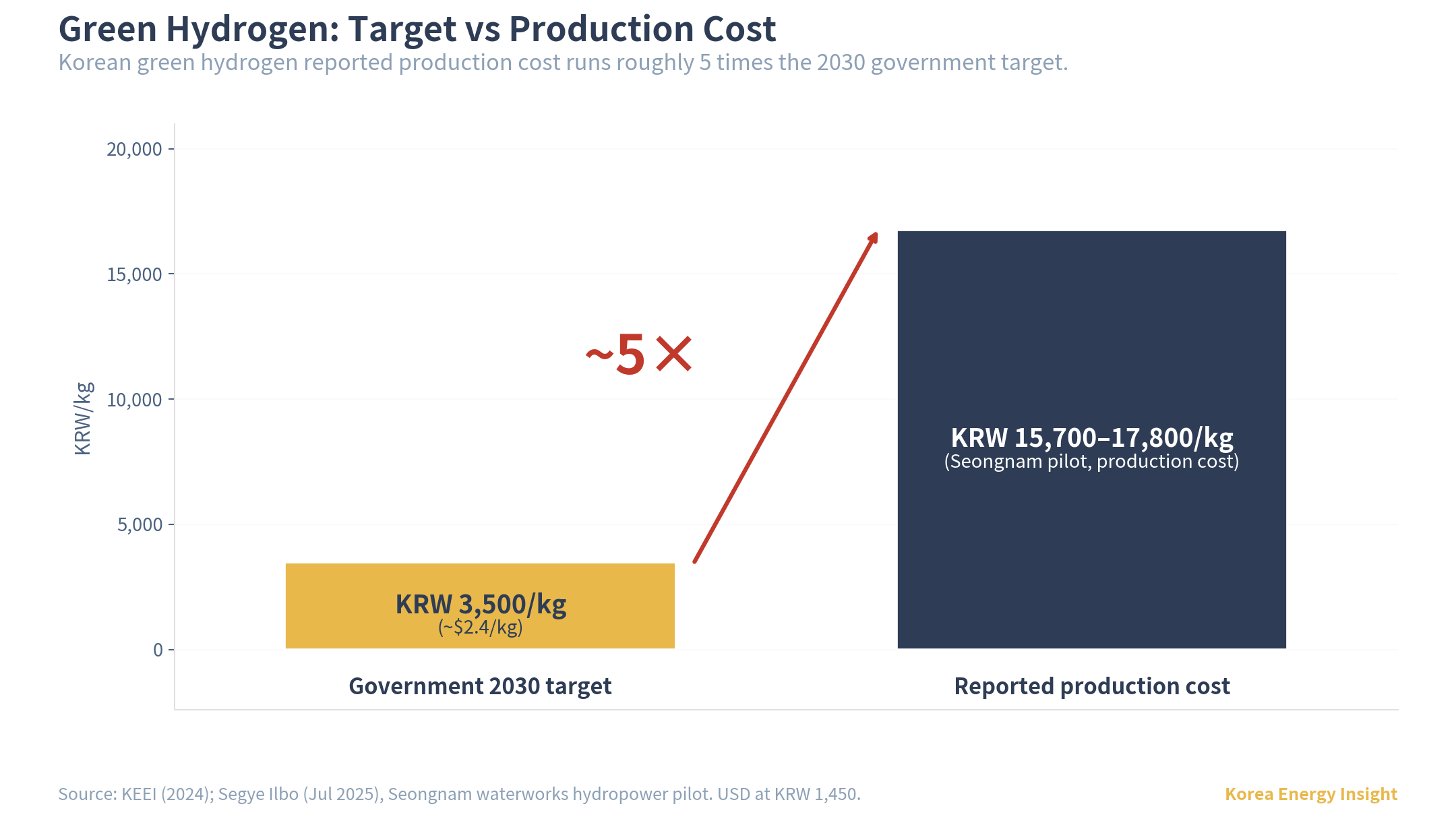
Green hydrogen LCOH remains too high to fill the gap on its own. KEEI’s analysis holds. The government’s stated 2030 target of KRW 3,500/kg (~$2.4/kg) is less a forecast than an aspiration. The Seongnam waterworks pilot reports production cost in the range of KRW 15,700–17,800/kg (Segye Ilbo, Jul 2025), four to five times the target. The largest domestic green hydrogen facility in operation as of early 2026 is Samsung C&T’s Gimcheon plant at 10 MW electrolysis capacity, producing roughly 230 tonnes per year. Set against the 11th Basic Plan’s 2030 hydrogen power target of about 15.5 TWh, Korea’s largest operating green hydrogen facility produces a sliver of what the auction structure is meant to fuel.
Pink hydrogen has become the policy escape hatch. Tier 2 sits in the same competitive grading bracket as green, with a similar near-zero emissions profile in the lifecycle calculation, but with the baseload availability that wind- and solar-coupled electrolyzers cannot match. KHNP, together with Samsung C&T, Doosan Enerbility, Hyundai E&C, and KEPCO E&C, is building a 10 MW low-temperature electrolysis pilot targeting 4 tonnes per day, with steel-industry offtake in mind (ZDNet Korea, Jul 2025). Climate Minister Kim Sung-hwan publicly directed KHNP to accelerate pink hydrogen R&D around the start of his tenure. Skepticism toward ammonia co-firing has been a consistent thread across Korean administrations — much like the cross-party commitment to coal phaseout — and Kim, who voiced that skepticism as a lawmaker, is now in the position to make it visible in policy direction. The political logic is consistent: shut down the bottom of the grading table, push capital toward the top.
Taken together, Korea’s clean hydrogen supply will not settle on a single pathway over the next ten years or more. Green and pink will contest the top slots while domestic blue hydrogen waits on a support mechanism that has not yet arrived. Samsung C&T’s presence across all three — Samcheok blue ammonia, Gimcheon green hydrogen, and the KHNP pink pilot — is what cross-pathway hedging looks like in practice.
Closing
Base case. The 4 kg standard holds. Pink hydrogen gains ground as Tier 2 becomes the most accessible high-scoring pathway, supported by active KHNP backing and public political direction. Imported ammonia co-firing does not return as a CHPS pathway — the Samcheok contract runs to term as the legacy case. Domestic blue hydrogen remains the only pathway that can produce meaningful volumes inside Korea on the relevant timeline, and work to make its economics defensible continues — through CCS development, project rescoping, and direct or indirect policy support discussions. The auction ceiling, on its current design, does not yet reward those efforts. The gap is a question, not a verdict. The re-auction opens in 2026 with a domestic-production restriction and clears a modest volume dominated by pink pilots and early-stage green hydrogen.
What I’m watching.
Whether the re-auction’s domestic-only provision is written as a hard rule or leaves a carve-out for strategic imports.
Whether MOTIE and MCEE reconcile their hydrogen signals into a single procurement framework, or let the gap widen further.
Whether the KHNP pink hydrogen pilot moves from 10 MW to commercial scale before 2028.
Whether clean hydrogen supply costs and the auction ceiling close the gap — whether through imported blue supply coming down, domestic green and pink LCOH falling, or a separate support mechanism for domestic blue hydrogen. The fuel-cost bottleneck turns on this.
What would change my mind. Two conditions would shift the base case.
First, MOTIE and MCEE accept that the fuel cost bottleneck cannot be solved inside the current CHPS price cap, even with Korean turbine capability on the horizon. They then open the general hydrogen auction, or a new track under CHPS, to utility-scale fuel cell projects above 100 MW per site. Korea already has the manufacturing base, the operating experience, and the installed precedent: the 78.96 MW Shinincheon Bitdream plant is proof that parallel-stacked fuel cells run at near-100 MW scale on a single site, and domestic manufacturers can deliver several hundred megawatts per year. The bottleneck is not technology or deployment. It is an auction design that prices for a fuel supply that has not arrived, while leaving the mix Korea can deliver today — utility-scale fuel cells — stuck in distributed generation.
Second, the introduction of a support mechanism for domestic blue hydrogen outside the CHPS price cap, tied either to CCS development funding or to capacity market compensation. The case is straightforward. The 11th Basic Plan’s 2030 hydrogen power target and Korea’s NDC commitments both require fuel volumes that green and pink cannot deliver on the timeline. If the mismatch becomes visible enough, the policy answer will not be to lower the target. It will be to support the only pathway that can meet it.
Either shift would reopen a pathway the current framework has closed by construction.
If this analysis is useful for your team’s Asia hydrogen strategy, consider sharing it with colleagues pricing CHPS contracts or evaluating Korean co-firing assets.