


MARKET SIGNAL | Image: GE 9HA gas turbine rotor via GE Vernova
The Shift
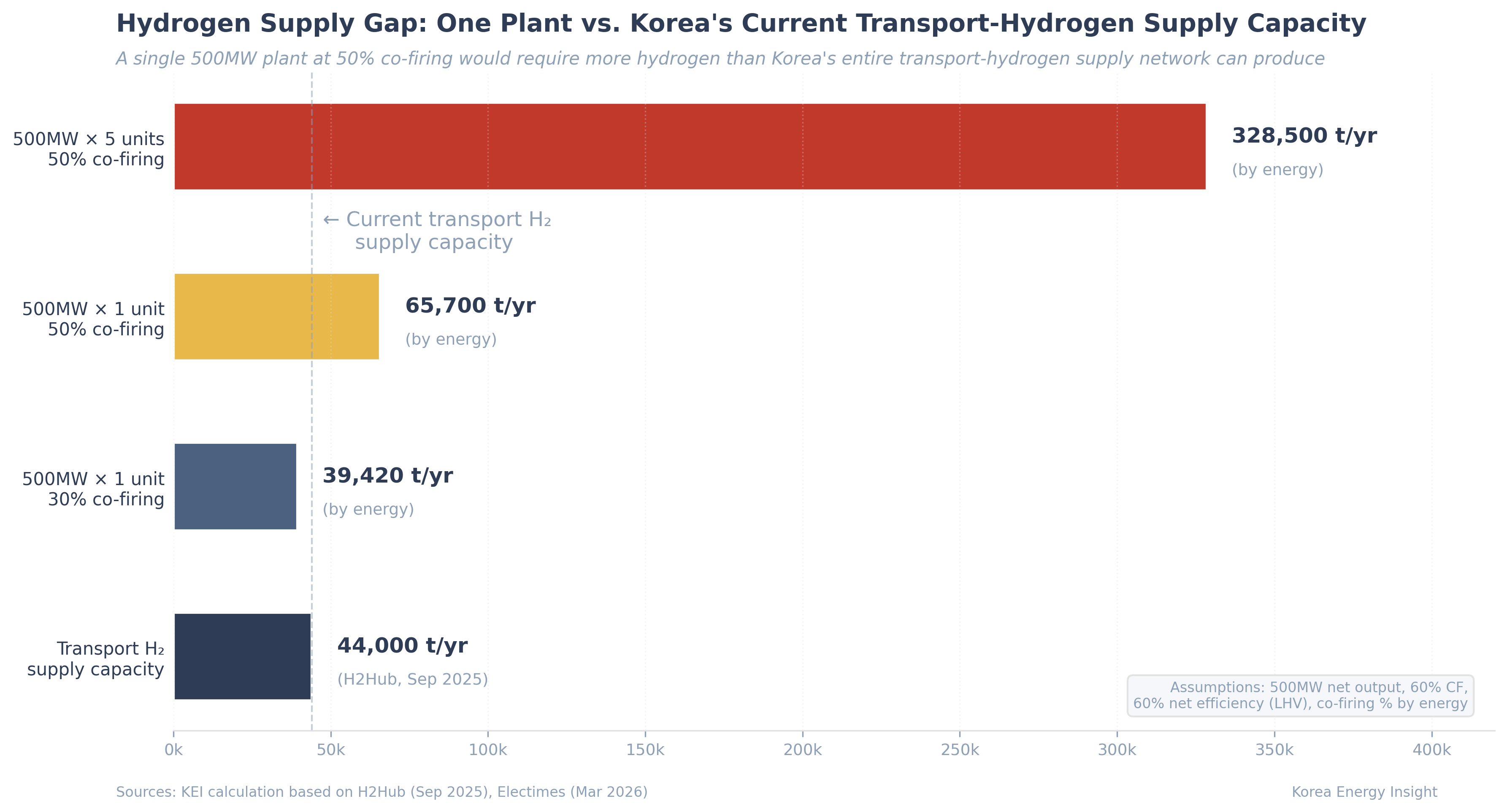
In March 2026, developers moving new LNG combined-cycle projects through Korea’s climate change impact assessment — conducted alongside the EIA for new power projects — started hearing a more specific question: where exactly will the hydrogen come from? A roadmap was no longer enough. The Ministry of Climate, Energy and Environment (MCEE) wanted the supplier, the volume, and the delivery timing. In some cases, according to developers involved in recent EIA consultations, the required co-firing ratio has reached 50% by energy. For a 500MW plant at 60% capacity factor and 60% net thermal efficiency (LHV basis), that means roughly 66,000 tonnes of hydrogen per year (Electimes, March 21, 2026; KEI calculation).
That is where the problem becomes visible. One plant at that level would require more hydrogen than Korea’s current dedicated transport-hydrogen supply infrastructure can produce in a year — about 44,000 tonnes (H2Hub, September 2025).
Why Hydrogen, Not Ammonia
The policy logic starts with Korea’s coal-exit trajectory. Japan chose a different path: retrofit coal plants with ammonia co-firing. JERA is testing 20% ammonia blends by heating value at Hekinan, scaling toward 50% — ammonia is commercially available and deployable within years rather than decades.
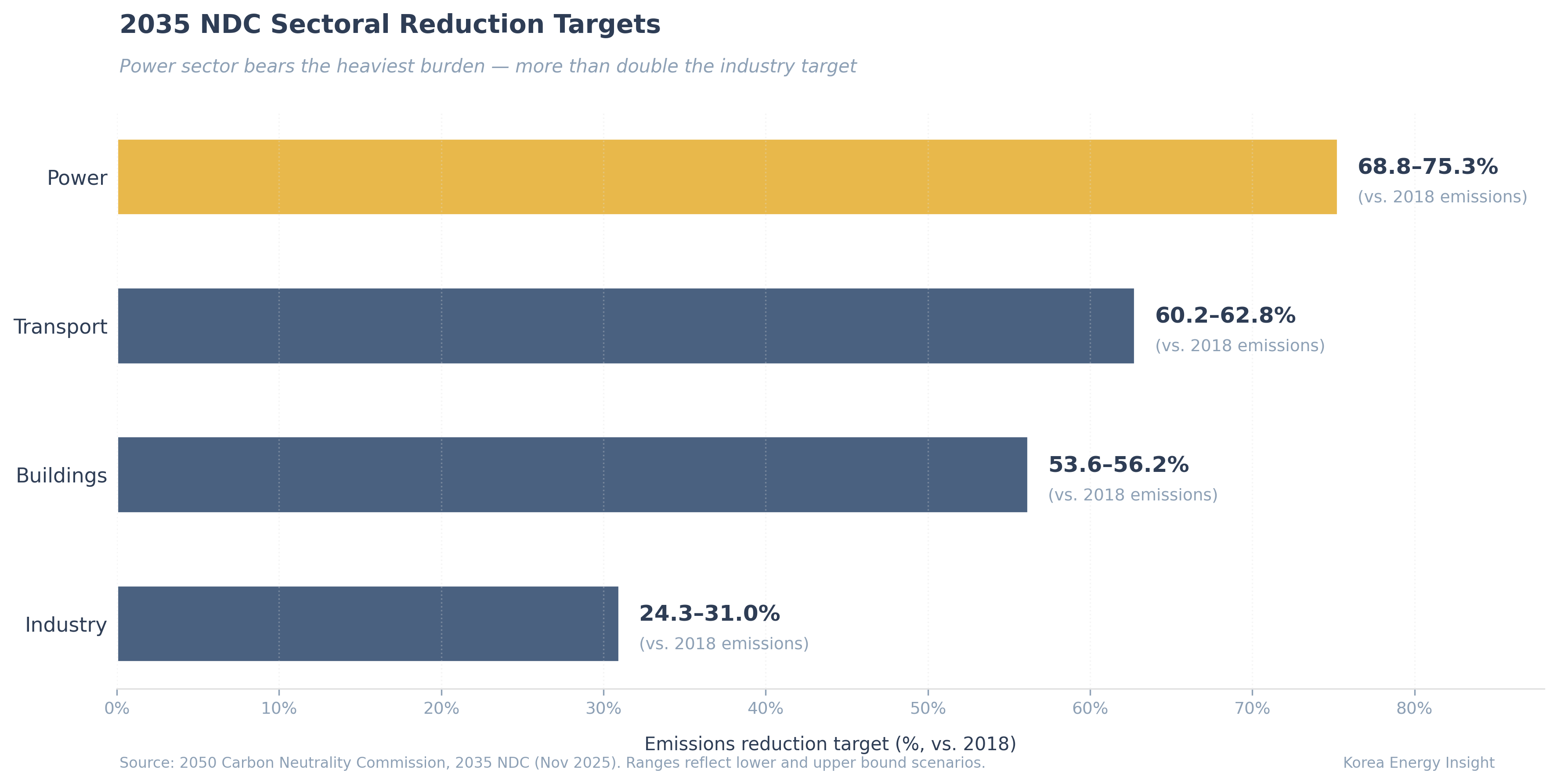
Korea’s coal-retirement push closed that door. In Korea’s policy mainstream, coal is a phase-out story, not a retrofit story — which means ammonia co-firing for coal plants makes no commercial sense. That leaves LNG as the sole fossil fuel in Korea’s long-term generation mix, and hydrogen as the decarbonization pathway that regulators are now testing at the permit stage. The 2035 Nationally Determined Contribution (NDC), finalized in November 2025, sets the power sector’s emissions reduction target at 68.8–75.3% from 2018 levels — more than double the 24.3–31% target for industry (2050 Carbon Neutrality Commission).
With LNG projected at just 15–16% of generation by 2035 (public power-sector NDC discussion, September 2025), every new gas plant faces an existential question: how does this asset fit in a grid that needs to cut power-sector emissions by three-quarters?
The climate EIA is where that question now lands.
Three Problems, Not One
Calling this a hydrogen supply issue understates the problem. Developers are running into three separate constraints: fuel availability, turbine performance, and delivery infrastructure.
First, the fuel doesn’t exist at scale. Korea produces roughly 2.5 million tonnes of hydrogen annually (H2Hub), but over 60% is captive byproduct hydrogen tied to petrochemical and refinery processes. The merchant supply available for power generation is effectively nonexistent at utility scale today.
Second, the combustion technology is not ready at the levels now surfacing in consultations. OEMs market turbines as “H₂-ready” at 30–50% co-firing by volume, but the requests developers describe are framed in energy terms. Those are not interchangeable, and the difference matters.
The engineering challenge is real. Hydrogen’s adiabatic flame temperature is 260°C higher than methane (2,210°C vs. 1,950°C; US EPA Technical Support Document), and its flame speed is roughly ten times faster (NETL Literature Review, 2022). In dry low-NOx (DLN) combustors — the standard design for modern combined cycle plants — high hydrogen concentrations create two unresolved problems: sharply elevated NOx emissions and flashback, where flame propagates upstream into the premixing zone and destroys hardware. At 100% hydrogen, unmitigated NOx under GE 6FA firing conditions can exceed 500 ppm (GE data reproduced in CATF, 2023); NETL separately notes that uncontrolled hydrogen flames can generate more than eight times the NOx of natural gas under comparable conditions (NETL, 2022). Typical permit limits for modern combined cycle plants sit in the single-digit to low-tens ppm range. OEMs are developing improved combustor designs, but developers say the commercial guarantees available today lag the claims in marketing material.
Third, the delivery infrastructure requires a parallel buildout. Hydrogen embrittlement — the irreversible degradation of pipeline steel exposed to hydrogen — means existing natural gas pipelines cannot carry high-concentration hydrogen. Dedicated or substantially upgraded pipelines are required. Korea has installed roughly 410 km of hydrogen piping (NKIS), almost entirely for small-scale industrial and refueling use. No utility-scale pipeline connecting a hydrogen source to a power plant is under construction.
No Global Precedent
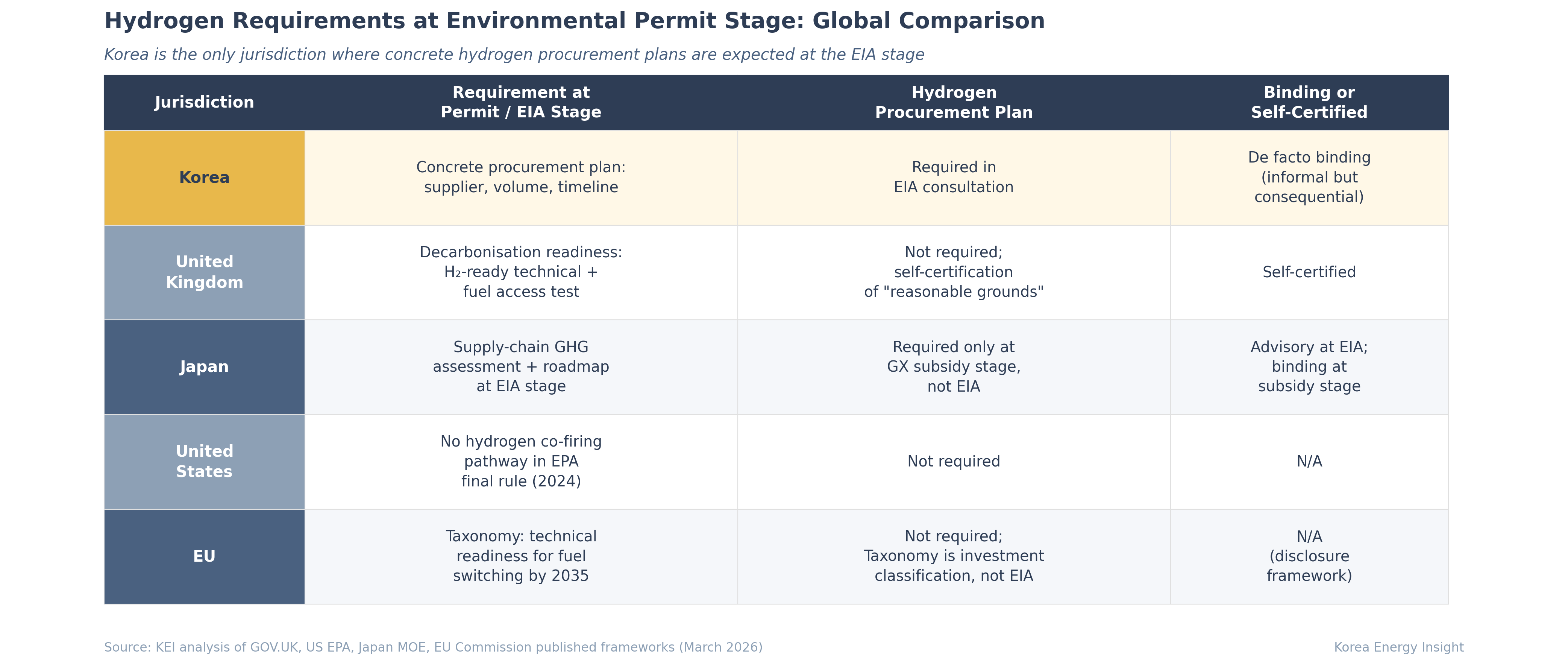
I have not found another major jurisdiction that asks developers, at the environmental-permit stage, to identify hydrogen suppliers, volumes, and delivery timing in this level of detail in publicly available regulatory frameworks. The UK comes closest: its decarbonisation readiness framework, effective February 2026, requires new plants to demonstrate hydrogen fuel access — but this is self-certified, not independently verified. Japan’s EIA process asks for supply-chain-wide GHG assessments and decarbonization roadmaps, but concrete procurement dossiers are required only at the GX subsidy stage, not the environmental permit stage. Why Korea is further ahead comes down to structure: it is phasing out coal and cutting power-sector emissions by up to 75% within a decade. That combination funnels all decarbonization pressure onto LNG — and from there, onto hydrogen.
Where the Projects Are
Roughly 5 GW of new LNG capacity is currently moving through EIA or recently permitted (based on KEI’s aggregation of EIASS filings and industry reporting), concentrated along the Yeosu-Gwangyang Bay-Hadong coastal corridor — over 3 GW from Korea Western Power, Korea East-West Power, Hanwha Energy affiliates, POSCO International, and others, clustering near existing LNG terminals and petrochemical complexes. The clustering is deliberate: these are the sites where hydrogen infrastructure — import terminals, blue hydrogen production, dedicated pipelines — would arrive first, if it arrives at all. The most prominent inland exception — the Yongin semiconductor cluster (1,050 MW) — lacks that optionality. Several projects have already embedded H₂-ready specs: Jeju Clean Energy Complex is designed for 50% hydrogen co-firing by volume from the outset, while Hadong LNG — a coal replacement — drew public criticism for not including hydrogen transition conditions.
Even without a formal written rule, developers are already behaving as if the requirement is real.
Base Case
The likeliest outcome is delay, not outright rejection. But that delay will hit projects unevenly. The climate EIA will continue to tighten hydrogen-related expectations through 2026–2027, driven by the 2035 NDC power-sector target. Coastal plants with Clean Hydrogen Power Supply (CHPS) experience and some supplier access have a plausible path through consultation — particularly at 30% co-firing levels where turbine technology is closer to proven. Inland plants without that optionality do not.
What I’m Watching
I’m watching three things: whether MCEE turns these consultation expectations into written guidance, whether any dedicated hydrogen pipeline actually breaks ground in 2026, and whether OEMs start offering commercial NOx and flashback guarantees at blend ratios above 30% by volume.
What Would Change My Mind
If Korea’s hydrogen pipeline buildout accelerates materially — construction contracts signed, not plans announced — the procurement barrier loosens. Alternatively, if the political calculus shifts and LNG’s 2035 share rises above 16%, the urgency to force hydrogen co-firing at the permit stage may ease. If neither of those shifts happens by the end of 2026, hydrogen procurement uncertainty is likely to show up as an explicit reason for delay in at least one major LNG project.
If this analysis is useful for your team’s Korea energy strategy, consider forwarding it to a colleague.