


MARKET SIGNAL | Image: LG Heat pump vis LG Electronics
On March 3, South Korea’s cabinet approved a decree recognizing air-source thermal energy as renewable energy; the revised enforcement decree took effect on March 10. Three days later, the Ministry of Climate, Energy and Environment (MCEE) unveiled a tariff change — effective April 1 — that gives eligible heat pump households new billing options, including separate metering of heat pump load under the general-service tariff rather than the residential progressive rate. The government’s target: 3.5 million heat pump installations by 2035, cutting 5.18 million tonnes of CO₂.
The target is ambitious, but the real obstacles are Korea’s climate, housing stock, and district-heating rules.
The Performance Gap
Air-source heat pumps extract warmth from outdoor air. Their efficiency — measured as Coefficient of Performance (COP) — drops as the air gets colder. How far it drops matters enormously for a country where Seoul’s January average is -1.9°C and the annual temperature swing reaches 28°C.
Publicly certified data from Samsung and LG air-to-water models registered under the European Heat Pump Keymark tells the story. Under favorable conditions (+7°C, low-temperature supply at 35°C), certified COPs exceed 6. But many existing Korean ondol systems operate above the 35°C benchmark — floor heating typically demands supply temperatures of 45–55°C, where COPs at the same outdoor temperature start closer to 4. At -10°C, performance drops to the low-2s regardless of application — the same heating output requires roughly three times the electricity. Below -7°C, frost accumulation on outdoor heat exchangers triggers defrost cycles that temporarily halt heating and materially reduce effective COP (ORNL).
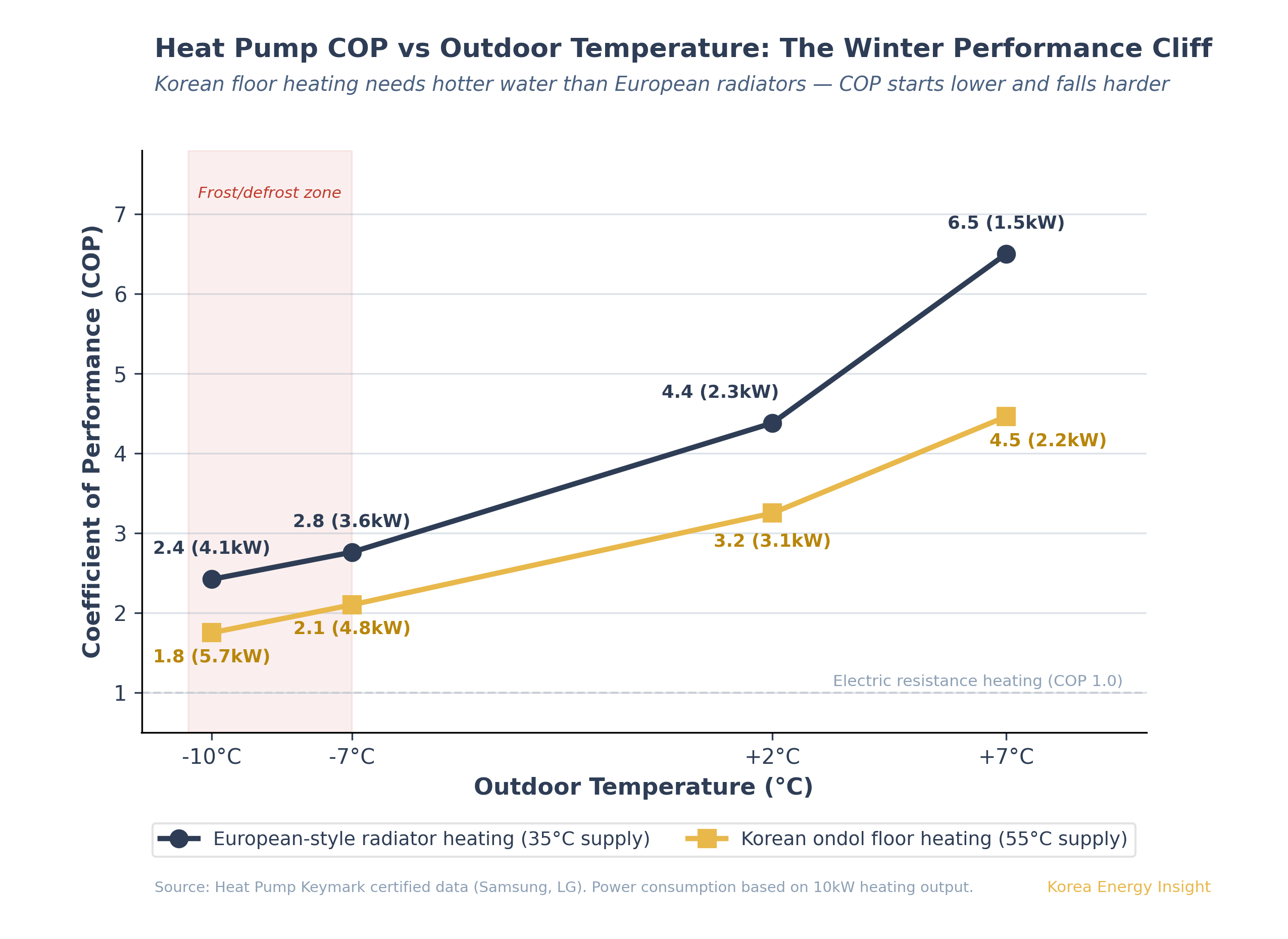
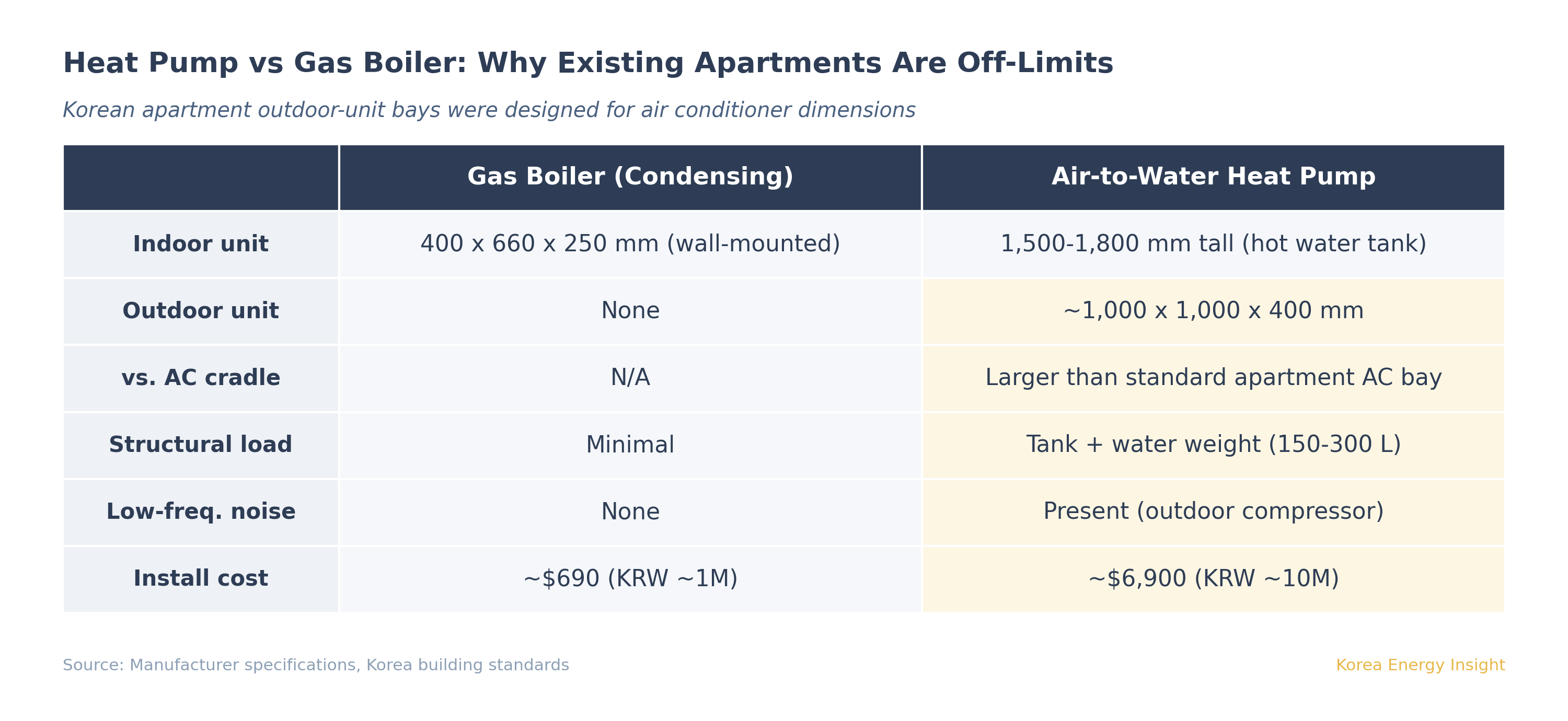
This does not mean heat pumps stop working in Korean winters. It means electricity consumption rises sharply when heating demand peaks — and that is when the economics turn against consumers. At COP 2.4, the operating cost advantage over a condensing gas boiler narrows or disappears. Add the upfront gap — roughly $6,900 (10 million won) for a heat pump versus $690 (1 million won) for a boiler — and consumer adoption hinges on how aggressively tariff design compensates for the performance cliff.
The government appears to understand this. Its initial deployment targets warm-climate regions — Jeju and Gyeongnam — and detached houses with rooftop solar, not Seoul apartments. The physical constraints explain why. A wall-mounted gas boiler measures roughly 400×660×250mm with no outdoor unit. An air-to-water heat pump requires an outdoor unit approximately 1,000×1,000×400mm — larger than a standard apartment air conditioner cradle — plus an indoor hot water storage tank standing 1,500–1,800mm tall. Korean apartment outdoor unit bays were designed for air conditioner dimensions, and the additional weight of a water tank raises structural load concerns for existing buildings. Low-frequency noise from outdoor units adds a further barrier. For existing apartment complexes, retrofit installation is extremely difficult.
The Legal Wall — and the Crack
Korea’s Integrated Energy Supply Act (집단에너지사업법), Article 6, requires government approval to install any heat-producing facility above a threshold capacity within a designated district energy supply zone. Administrative practice has functioned as a near-absolute barrier, protecting district energy operators’ captive heat customer base. District energy currently supplies 3.78 million households — 19.4% of Korea’s housing stock (Korea Energy Agency, 2023).
There is one exception. Article 8(2)(ii) of the enforcement decree exempts heat production facilities that use renewable energy as defined under the Renewable Energy Act. Until March 10, only geothermal and hydrothermal qualified — air-source heat pumps sat outside the definition. Now they are in. March 10 created, for the first time, a legally credible exception pathway for air-source systems inside district heating zones. What remains unclear is how the ministry will interpret and apply the exception in practice. This does not mean retail heat competition opens overnight. The Act separately prohibits heat producers from selling directly to users inside supply zones. The risk to district energy is not third-party competition but self-provision: users or developers in multi-unit housing and new developments opting out of the district heating network entirely.
What Is at Stake
Korea District Heating Corporation (KDHC) reported $2.8 billion (KRW 4.0 trillion; all USD conversions at approximately KRW 1,450/USD) in 2025 revenue — heat 44%, electricity 53% (KDHC 2025 annual report). Heat revenue is the stable base that absorbs wholesale power market volatility. If heat pumps eventually enter district energy supply zones, CHP operators lose that buffer.
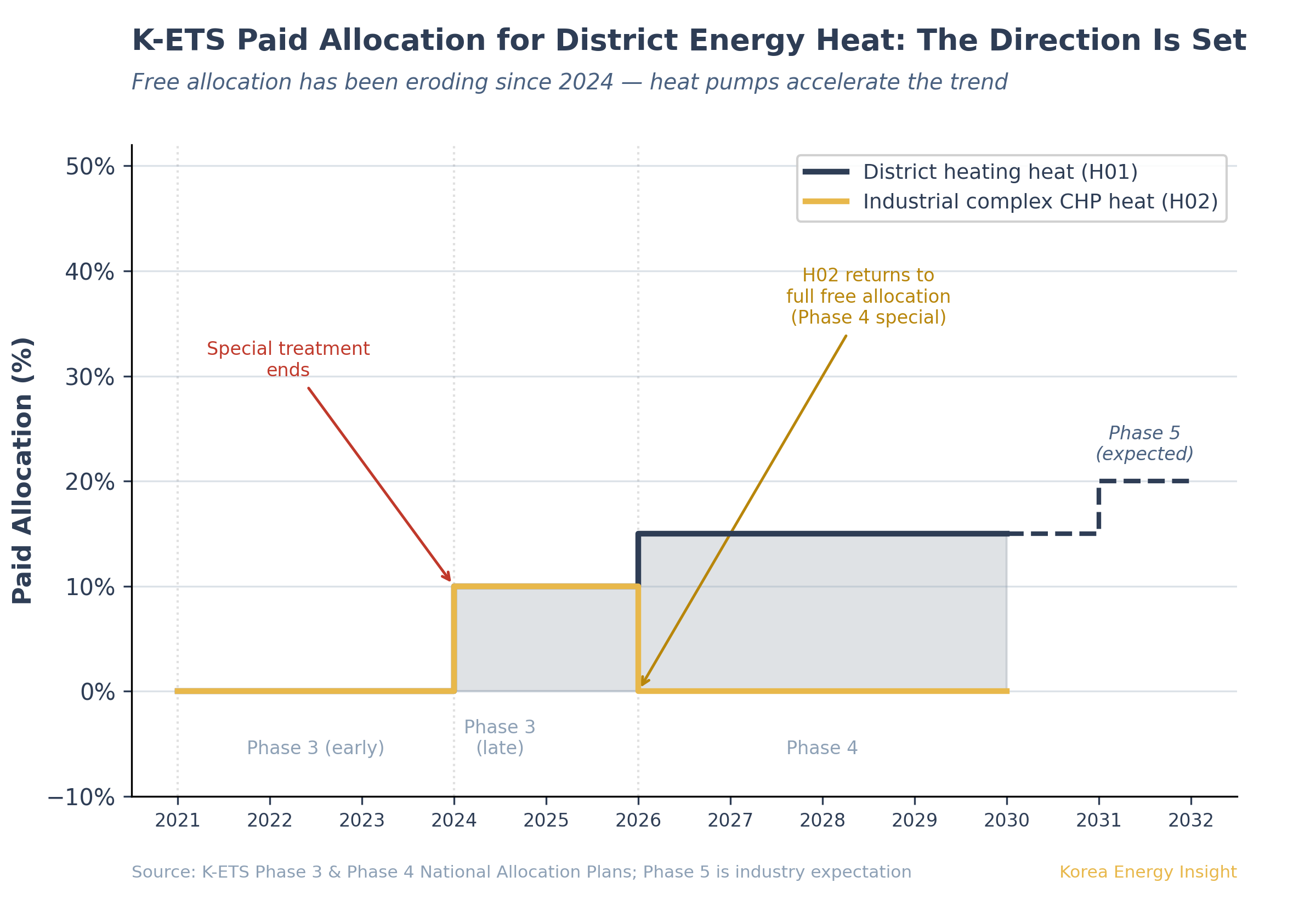
The first sector to feel pressure is city gas, not district energy — heat pumps will displace individual gas boilers outside supply zones first. But over the medium term, the bigger issue is the business model. At the start of K-ETS Phase 3, district energy heat was effectively fully free-allocated. By 2024, that had already shifted to 10% paid allocation. Phase 4 (2026–2030) deepens the trend to 15% for district heating heat, while industrial complex CHP heat retains full free allocation as a special category. Industry sources expect further increases in Phase 5. Heat pumps accelerate this direction — if they become a viable zero-direct-emission alternative, the parity argument that justified free allocation weakens further.
Why This Matters for Investors
The risk shows up first in three places.
The most direct is Korean CHP. A plant that loses its heat customer base becomes an ordinary LNG generator competing on wholesale price alone. Korea’s wholesale electricity price has trended lower since the 2022 energy crisis peak, driven by growing renewable and nuclear capacity — and barring frequent supply shocks like the Hormuz crisis, the long-term trajectory points further down. For infrastructure assets with 20–30 year horizons, a 5–10 year risk to the heat revenue base should already be part of how these assets are valued.
The second is Korean LNG market entry. New LNG capacity is effectively confined to the CHP pathway under the 11th Basic Plan: 2.2 GW of new LNG CHP is slated for 2031–32 via the capacity market, with a 0.9 GW pilot bidding round already completed and the balance still subject to the main auction. If heat demand erosion weakens the economics of that entry route, the investment case for Korean gas power narrows further.
The third is carbon allocation. The shift to 15% paid allocation in Phase 4 is the first move. Heat pumps give regulators a reason to accelerate — and unlike fuel cost, carbon cost cannot be passed through under the current tariff structure without regulatory approval.
Base Case
Heat pumps gain traction in detached housing and off-gas-grid areas over the next two to three years. District energy supply zones remain protected by administrative practice — the ministry is unlikely to confirm the heat pump exception while actively promoting district energy expansion. The exception pathway exists in statute, but no one has tested it yet.
What I’m Watching
Whether MCEE issues administrative guidance on heat pump applicability under Article 8(2)(ii). New apartment building codes — if heat pump-ready designs become standard, the pipeline of captive district heating customers shrinks before any regulatory change. KDHC’s heat revenue trend — one of the first things I’d watch.
What Would Change My Mind
An explicit MCEE ruling that air-source heat pumps qualify for the district energy zone exception. A revision of mandatory district heating connection rules for new developments. Either would accelerate the timeline from “5–10 year structural risk” to “a near-term valuation issue for CHP assets.”
If this analysis is relevant to your Asia energy or infrastructure strategy, consider sharing it with colleagues who evaluate Korean utility and CHP assets.