


Market Signal
Every link broke at once
On April 30, 2026, the Anma offshore wind project (532MW, off Yeonggwang in southwestern Korea) lost its turbine, cable, substructure, and tower contracts on the same day. Siemens Gamesa exited as its supply agreement lapsed. SK Ocean Plant (substructure), LS Cable & System (subsea cable), and CS Wind (tower) all withdrew. Copenhagen Infrastructure Partners (CIP) walked away from acquisition talks after failing to agree repayment terms with the HSBC-led lender group, which public reporting indicates holds a pledge on Equis Development’s 78% sponsor stake. Internal discussions on liquidation have begun. The project will be delayed at least one year (Electimes).
This was not one shock. It was the simultaneous collapse of every supply chain and financing link in a project that had not generated revenue in nine years.
The signal
The contrast point arrived two weeks earlier: Sinan-Wooi (390MW), in the same market under the same auction regime, reached financial close. Cost inflation and weaker revenue visibility created stress at both projects. Sponsorship architecture determined which one could absorb it.
Why Anma couldn’t absorb it
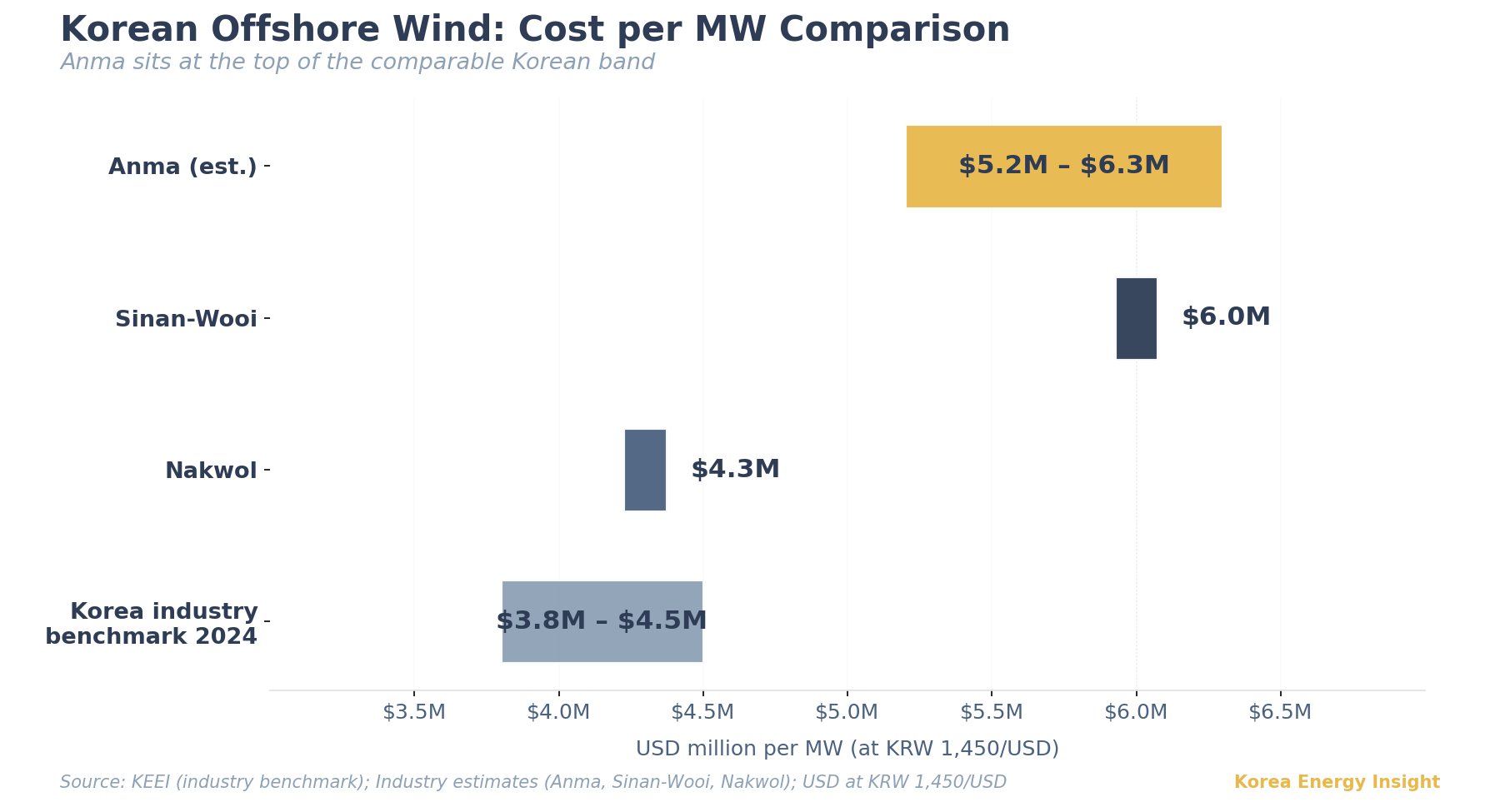
The economics were already under stress in 2023. Anma was disqualified from that year’s first offshore wind auction for bidding above the price ceiling (MOTIE auction results). The government raised the 2024 ceiling to KRW 176,565/MWh to absorb global cost inflation, and Anma was selected on the second attempt. But cost estimates have since climbed faster than the ceiling. Industry sources put Anma’s total project cost at $2.8B–$3.4B (KRW 4.0–4.9 trillion; all USD conversions at approximately KRW 1,450/USD), or $5.2M–$6.3M/MW (KRW 7.5–9.2 billion/MW). The Korean industry benchmark for 2024 sat at $3.8M–$4.5M/MW (KRW 5.5–6.5 billion/MW, per Korea Energy Economics Institute). Sinan-Wooi, the comparable domestic project, came in at $6.0M/MW (KRW 8.7 billion/MW). Nakwol — also in Yeonggwang waters — closed at $4.3M/MW (KRW 6.3 billion/MW). Anma sits at the top of the comparable Korean band, and unlike Sinan-Wooi, has no shock absorber below it.
The deterioration is structural rather than Korea-specific. The UK raised its AR6 offshore wind strike ceiling in 2024. Japan’s 2030 cost reference runs 13% above the European baseline. Multiple European developers booked impairments or cancellations in 2024–2025 citing inflation, monopile cost, and financing pressure. What is Korea-specific is that Anma’s sponsor, Australian infrastructure fund Equis, could no longer absorb cost overruns at its own hurdle rate without a domestic policy cushion underneath.
The revenue side weakened in parallel. The System Marginal Price (SMP) declined from KRW 196.65/kWh in 2022 to KRW 167.11 in 2023, KRW 128.39 in 2024, and KRW 112.72 in 2025. The first four months of 2026 ran KRW 103.53–118.92 (Korea Power Exchange). The 2022 peak that anchored sponsor upside cases is no longer a plausible base. The 2026H1 fixed-bottom offshore wind auction ceiling was set at KRW 171,229/MWh, 3% below the prior year. The government cushioned costs in 2024 and partially reversed in 2026.
Corporate Power Purchase Agreement (PPA) does not give Anma a clean escape route. Korean PPA contract prices ran KRW 170–180/kWh in 2025, with all-in costs including Renewable Energy Certificate (REC) reaching KRW 210–240/kWh (KEI aggregation of market reports). Transmission and distribution wheeling charges are billed separately under KEPCO’s direct power transaction rules. The government issued a PPA wheeling subsidy in late 2024, which is itself an admission that grid costs are a binding constraint. Honam-region grid congestion compounds the problem: 470.9MW of regional renewables entered semi-central dispatch in spring 2026, and the first phase of the Honam-Capital HVDC link does not arrive before 2031. Offshore wind PPA priced for risk in this window is uncompetitive against solar and onshore wind blends.
Cost pressure and revenue compression alone do not break an offshore wind project. They put pressure on the third dimension: time. That is where Anma had the least margin.
Nine years compounded the damage. Anma was incorporated in September 2017. Generation business permits arrived in 2019 and 2020. Grid connection contract in 2021. Environmental impact assessment closed in July 2023. First auction disqualification in December 2023. Auction selection in December 2024. Seabed use permit in August 2025. REC contract in September 2025. Full-stack collapse in April 2026. Based on available reporting, Equis financed not just the equity but the development expenditure through external debt, and HSBC’s syndicate held a pledge on the sponsor’s shares. This is not standard. Most sponsors carry development expenditure on balance sheet so delay erodes equity returns but preserves decision rights. Anma did not have that protection. Delay did not just reduce IRR. It moved control from sponsor to lender. By April 2026, the question was no longer whether Equis wanted to continue. It was whether Equis still controlled the decision.
Why Sinan-Wooi could
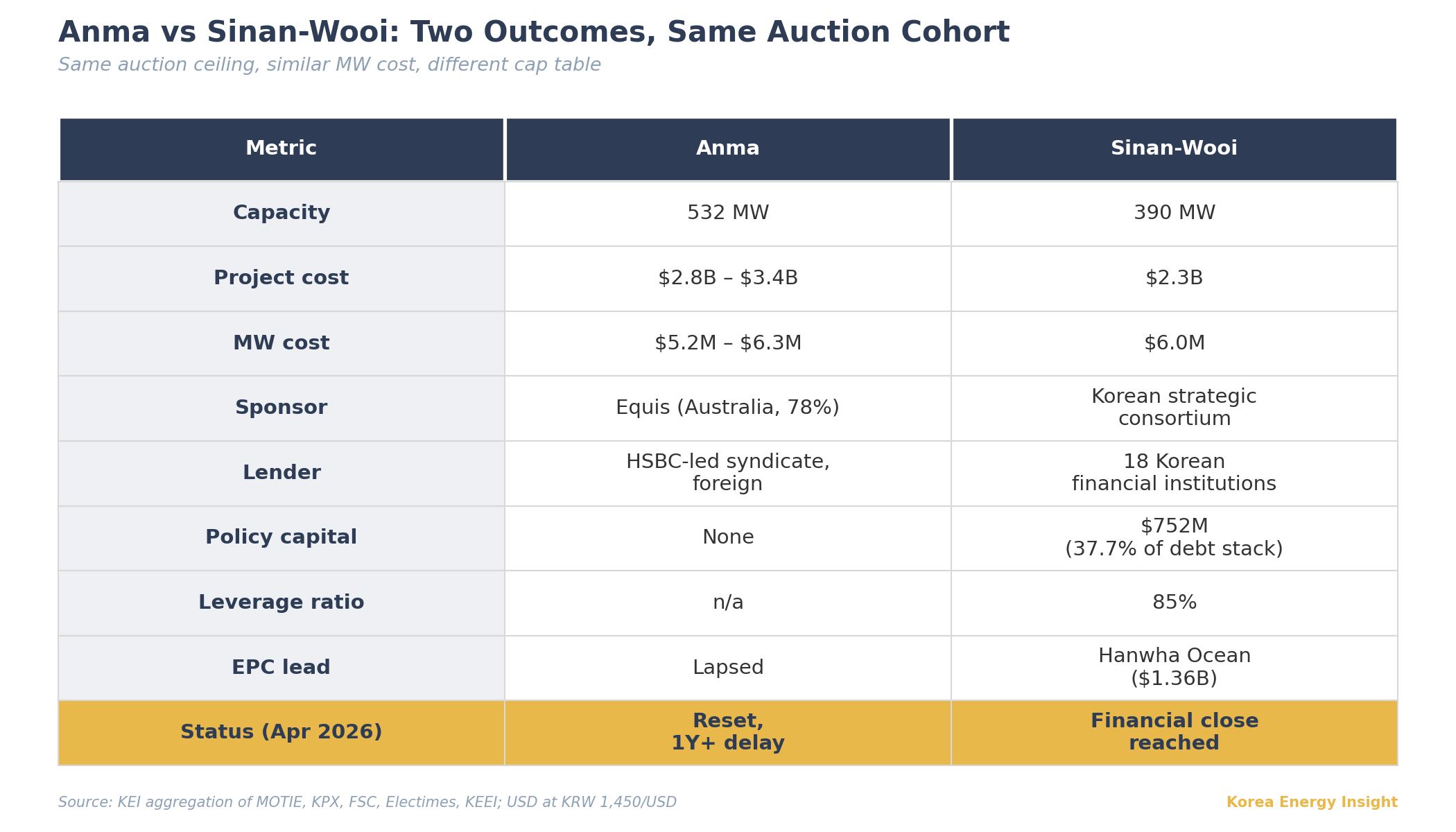
The reference case is one month old. Sinan-Wooi (390MW) reached financial close in April 2026 on a $2.3B (KRW 3.4 trillion) budget. The Strategic Industry Fund senior tranche contributed $483M (KRW 700 billion). The Future Energy Fund and Strategic Industry Fund subordinated tranches contributed $269M (KRW 390 billion). Combined policy capital reached $752M (KRW 1.09 trillion), or 37.7% of the debt stack (Financial Services Commission). Total debt reached $1.99B (KRW 2.89 trillion) against the $2.3B budget — an 85% leverage ratio that exceeded the 70–80% sector norm. Policy capital made that leverage possible. Eighteen Korean financial institutions joined. Korea Midland Power took O&M. Hanwha Ocean led the EPC consortium.
Foreign infrastructure fund vehicles active in Korean offshore wind target fund-level net IRR in the low-teens (CIP flagship funds at 10–14% net, per CIP Annual Report 2023). Korean strategic investors underwrite at lower hurdles. The more important distinction is where return is recovered. Strategics recover economics outside the project SPV through EPC margin, supply-chain throughput, and long-term offtake synergies. Hanwha Ocean’s $1.36B (KRW 1.97 trillion) EPC scope at Sinan-Wooi is the visible expression of those wider strategic-level economics.
Sinan-Wooi did not close because its economics were stronger. It closed because its cap table absorbed shocks the project economics could not. Same auction ceiling. Similar MW cost. Different outcome.
Two paths
Two paths remain for Anma. Hanwha Ocean or another Korean strategic acquires at a discount steep enough to write down Equis’s nine years of sunk cost. The acquirer picks up EPC margin alongside equity, refinances through domestic policy banks, and rebuilds the cap table on the Sinan-Wooi template. In 2019, Macquarie sold the Yeongyang and Yeongdeok onshore wind portfolio to Samtan and Shinhan Alternative Investment Management at $131M (KRW 190 billion). Combined project cost was $171M (KRW 247.5 billion), a 0.77x ratio. The acquirer implemented a 90% capital reduction and converted equity to shareholder loans. Korean distress acquisitions rewire cash flow priority and timing rather than reset headline IRR. Or liquidation. Hanwha Ocean has publicly denied acquisition talks while confirming EPC participation, which is consistent with either category at this stage. Either path closes off the foreign-sponsor-led model as a standalone bankability template for this auction cohort. Foreign sponsors can still participate. But they can no longer be the only shock absorber. The 2024 auction selected several projects. The Bandibuli floating-wind REC contract failure and Anma’s reset have already removed two from likely commercial operation by 2030. The pattern is no longer one project.
Base case: Anma resets for at least 12 months. The eventual acquirer, if one emerges, is a Korean strategic with EPC margin and a domestic lender syndicate. Foreign-sponsor-led deals on the 2024 auction list do not reach commercial operation without restructuring into the domestic template.
What I’m watching: Whether Hanwha Ocean’s EPC role formally extends to equity. Whether Yeonggwang County’s community payment demand gets absorbed into the Offshore Wind Special Act committee framework, in effect since March 2026. How HSBC’s syndicate books the loss, and whether that closes foreign lender appetite for Korean offshore wind senior debt for the next auction cycle.
What would change my mind: CIP returning with revised terms and reaching agreement with HSBC on debt repayment. Another 2024 auction project closing financing with full foreign sponsor stack, foreign lenders, and foreign turbine. Korean policy capital deployed into Anma on the Sinan-Wooi model while the existing foreign sponsor structure remains in place. Yeonggwang’s community payment resolved bilaterally rather than templated.
If a foreign-sponsor-led model still works in Korean offshore wind, Anma will not be the proof point.
If this analysis is useful for your team’s Asia infrastructure desk, consider forwarding to a colleague evaluating Korea offshore wind.